

Dem Primary Debate Was Civil, But Not Without Tried and True Rhetorical Devices
By Lauren Lifke
News Analysis
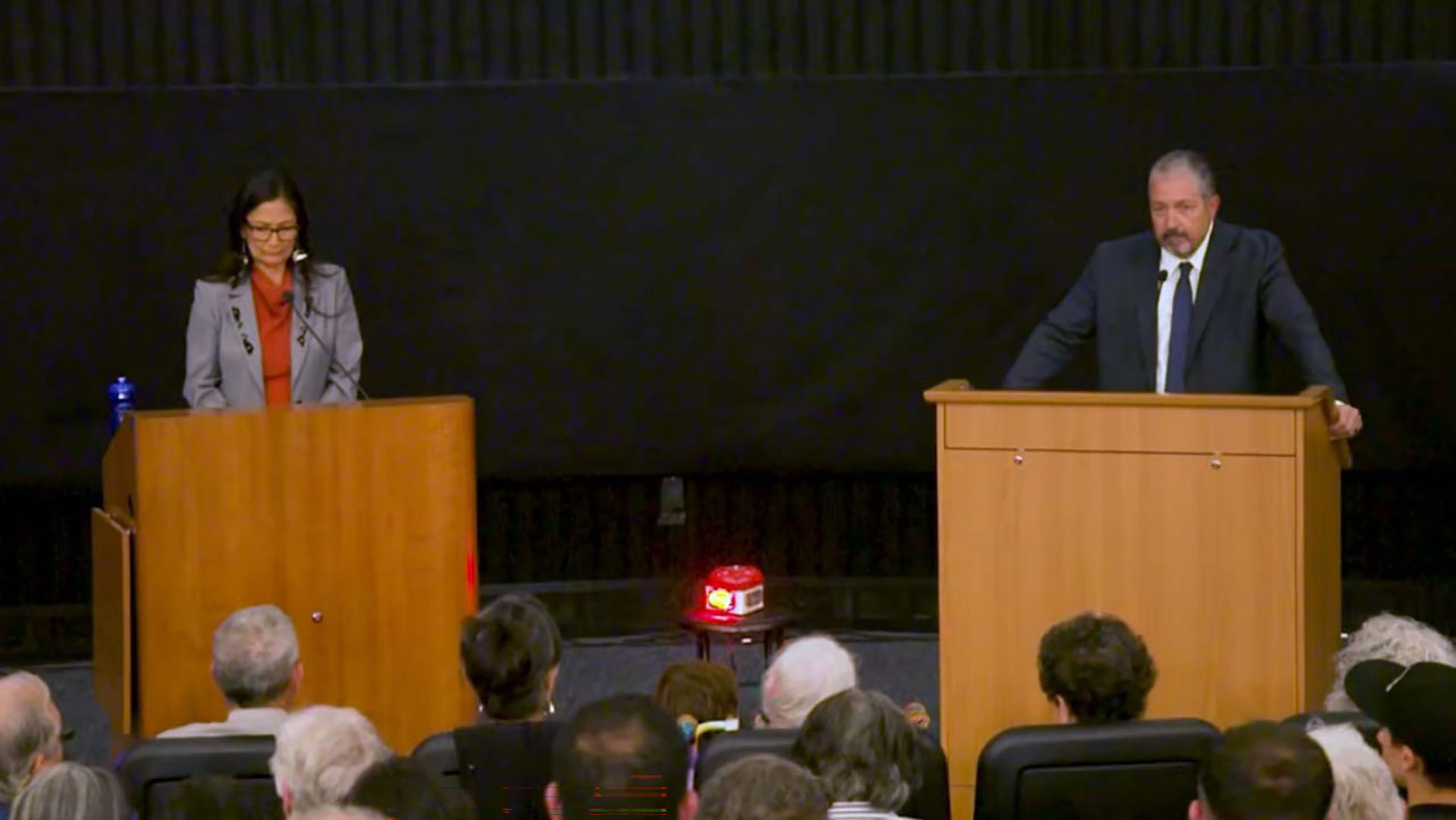
During the 2026 “Debate Games,” Democratic candidates Deb Haaland and Sam Bregman argued for why they should become New Mexico’s next governor. The event took a somewhat unconventional route, opening with a team of speech-and-debate students competing against each other — and with the candidates. And the debate itself featured a jury that decided whether each candidate had fully answered questions from moderator Gwyneth Doland, a longtime journalist and associate chair of the UNM Communication and Journalism Department.
The matchup marked the first and only debate between Bregman and Haaland ahead of the June 2 primary election — though there’s been plenty of consternation and handwringing over whether it was, in fact, a “real debate.”
It was organized by Dukes Up, a charitable organization that promotes pro-democracy events, conversations and, yes, debates. Dukes Up solicited questions from organizations around the state — including a healthcare workers’ union, the American Civil Liberties Union of New Mexico and the Tribal Education Alliance — and wrote a few themselves. After opening remarks from Haaland and Bregman, Doland tossed the questions to the candidates in rotating order, giving each 90 seconds to answer. Their opponent had a minute to rebut, followed by a 30-second response from the original answering candidate.
The unconventional aspect, Dukes Up’s Mark Fine told NMPBS, was the jury aspect. There were five of them, each tasked with deciding whether the candidates substantively answered a question with their 90-second opening. If a majority decided the candidate did answer, the candidate preserved their 30-second response at the end of each round. If three jurors decided the candidate had ducked the question, those 30 seconds would be forfeited.
It never came to that. There were some close calls, but a majority of jurors gave the thumbs-up in each round.
The debate was a mostly civilized affair, with the candidates rarely drawing out the knives to attack each other. But both Haaland and Bregman leaned occasionally on another tried-and-true political debate tactic: the logical fallacy.
In 2024, I published two stories for the Daily Lobo highlighting a few of the (many) logical fallacies candidates rolled out in the presidential and vice-presidential debates. The Donald Trump vs. Kamala Harris and J.D. Vance vs. Tim Walz debates were much more heated events, but they did share a healthy dose of logical fallacies with the Debate Games.
A logical fallacy, according to Merriam-Webster, is reasoning that comes to a conclusion without evidence to support it. This can come in the form of flawed reasoning, avoidance of a question, shortcuts or arguments that lack full evidence.
Below are some of the fallacies I noted during the Debate Games. Enjoy!
Red herring:
Ah, everyone’s favorite and a classic logical fallacy: the red herring, an argument that avoids opposing arguments instead of addressing them, according to Purdue OWL. This was the most common logical fallacy used during the Debate Games, with both candidates occasionally diverging from the questions at hand.
For example, ACLU-NM submitted a question asking for specific policies Bregman and Haaland would stand up to limit mass surveillance and establish data privacy protections for all New Mexicans.
“We need to make sure that our children are educated about the internet and about social media,” — Haaland
“I’m reminded of the fact that juveniles are getting guns using the internet to do it” — Bregman
Red herrings all around!
In response to the ACLU questions, both candidates also dredged up the ongoing Meta trial in which state Attorney General Raúl Torrez sued the social media giant for misleading the public on risks for teens. Though neither candidate used directly flawed reasoning, they both strayed from the original question addressing data privacy protections.
Let’s call those portions of their answers mini-red herrings.
Moral equivalence:
The moral equivalence fallacy is ever-so-common when it comes to politics — more often used in arguments between Democrats and Republicans, as opposed to the setup at the Debate Games, which of course pitted Dems against each other.
Moral equivalence happens when somebody argues that two deeds are equally immoral, even if one is minor and another is a major atrocity, according to Purdue OWL.
A question submitted by advocacy group Indivisible Albuquerque inquired about the reuse of fracking wastewater. Oil and gas exploration and drilling provides a large part of the state’s budget, but uses a large portion of our fresh water as well, according to the submitted question.
“Governor Lujan Grisham pushed to allow fracking wastewater to be treated and reused for industry. What is your position on the reuse of fracking wastewater?” Doland asked.
Bregman did not directly offer his position on the reuse of fracking wastewater. Instead, he compared it to reused sewage water for parks and golf courses in Albuquerque.
“Reused water of any type — we need to make sure that it’s cleaned up…We have to get ahold of this water issue.” — Bregman
Bandwagon:
If you’ve ever heard the term “hopping on the bandwagon,” then this one might sound familiar.
A bandwagon appeal happens when a person makes their argument by addressing those who support it. It presents what some people think in order to persuade others to think the same way, according to Purdue OWL.
The Tribal Education Alliance submitted a question asking the candidates what actions they would take to implement mandates from the landmark Yazzie-Martinez education equity lawsuit against the state. When Doland asked the candidates what actions they’d take to comply with the mandates that resulted from the lawsuit, Bregman brought in the bandwagon.
“I’ve been endorsed by Sandia, Ohkay Owingeh, the Jicarilla Nation.” — Bregman
While not irrelevant — the mandate includes improving education for Native youth — the statement did fall under the category of the bandwagon appeal.
Either/or fallacy:
If you have a tendency to think in black-and-white, then chances are you’ve used the either/or fallacy, which occurs when one argues that there are only two sides or choices in an argument, according to Purdue OWL.
Doland asked the candidates a question from Dukes Up about how they’d seek to diversify the state’s revenue streams. Haaland pivoted to an interaction she had with a tribal council member.
“One of the councilmen raised his hand and said, ‘Are we a rich state or a poor state?’” — Haaland
The former U.S. Interior secretary went on to note that New Mexico has plenty of money in its savings accounts and that it should be reinvested, but she didn’t weigh in on the rich vs. poor question.
Bregman did, but he also responded in a way that suggested there are only two answers to that question.
“We’re a rich state, because we have $75 billion in wealth funds, but that is not shared with every person.” — Bregman
Genetic fallacy:
The genetic fallacy is a classic that has been used to justify all sorts of wrongdoing throughout history. Purdue OWL defines it thusly: when one argues that the origins of a person define their character.
Throughout the debate, Haaland brought up her old job at Interior. Though it was often relevant to the questions at hand, there was one instance that sparked backlash from her opponent.
Jewish Voice for Peace submitted a question inquiring about how the candidates would take a stand against federal military action.
“I know how to hold (Trump’s) feet to the fire, because I’ve done it before. I was on the House Armed Services Committee when I served in Congress.” — Haaland
She cited holding President Donald Trump’s feet to the fire without clarifying exactly how.
“I actually am not aware, Deb, of any holding Mr. Trump’s feet to the fire on your part,” Bregman replied.
Lauren Lifke is an independent journalist based in Albuquerque.
