

The Pecos River Still Flows. But for How Long?
Water deals, decades of drought and a booming oilfield reshape life along a legendary New Mexico river.
by Jerry Redfern, Capital and Main
This story was originally published at Capital and Main, a NMPBS partner.
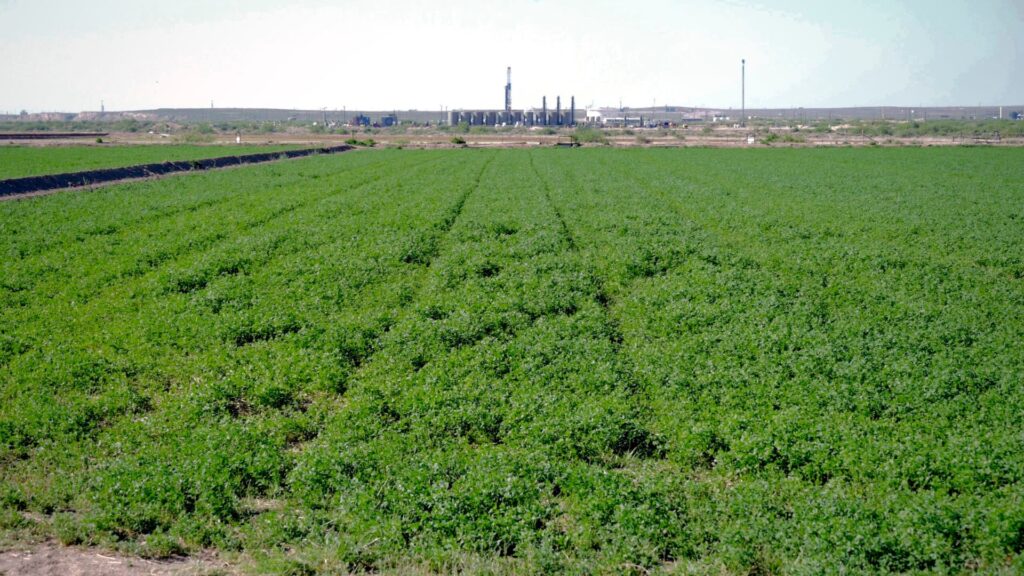
Johnny Reid has spent nearly all of his life on a couple of farms set in the few square miles between Loving, New Mexico, and the Pecos River. “It’s been a very enjoyable life,” he said, looking out over the tan and green Pecos Valley.
This farm and others in the area are known for their high-quality alfalfa. His son drives the Reid family harvest — several times a week, 28 tons a trip — to horse breeders in Texas.
Acres of deep-green alfalfa all but surround Reid as he stands in the shade of a hay barn on the eastern edge of his property. He tells stories of the occasional itinerant bobcat, coveys of quail and a herd of deer seen on the farm. “We would come down here at night and show them to our grandkids,” he said.
Or he used to. Noise and trucks have taken their toll on the deer. “They get hit on the highway a lot,” Reid said. That busy highway, hidden behind a rise about a mile away, runs through the middle of the Permian Basin, the nation’s most productive oilfield, which surrounds the Reid farms.
And as if to prove the point about the noise, it’s hard to hear Reid, even standing behind a 12-foot wall of hay bales.
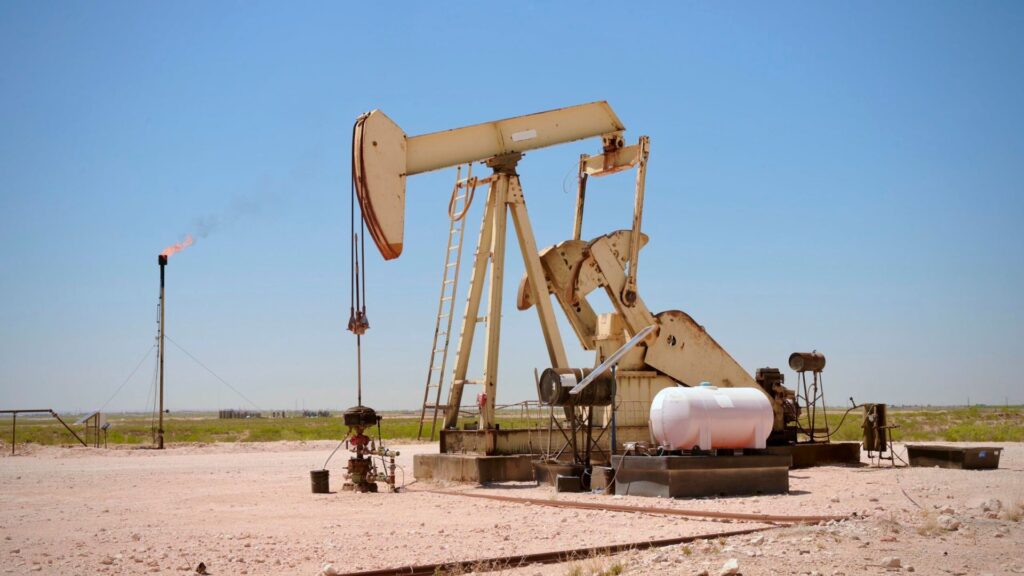
On a wellsite 200 yards away, the sound from a brace of oil separators, an on-again, off-again flare, nine wellheads, a dozen storage tanks and a massive diesel generator all mix into a hissing roar like an idling 737.
“It really don’t bother me,” Reid said. The noise from a set of compressors moving natural gas through pipelines to the south was worse. “At night when it’s calm, you can hear ‘em vibrating. It sounds like there’s water running in the house or something.”
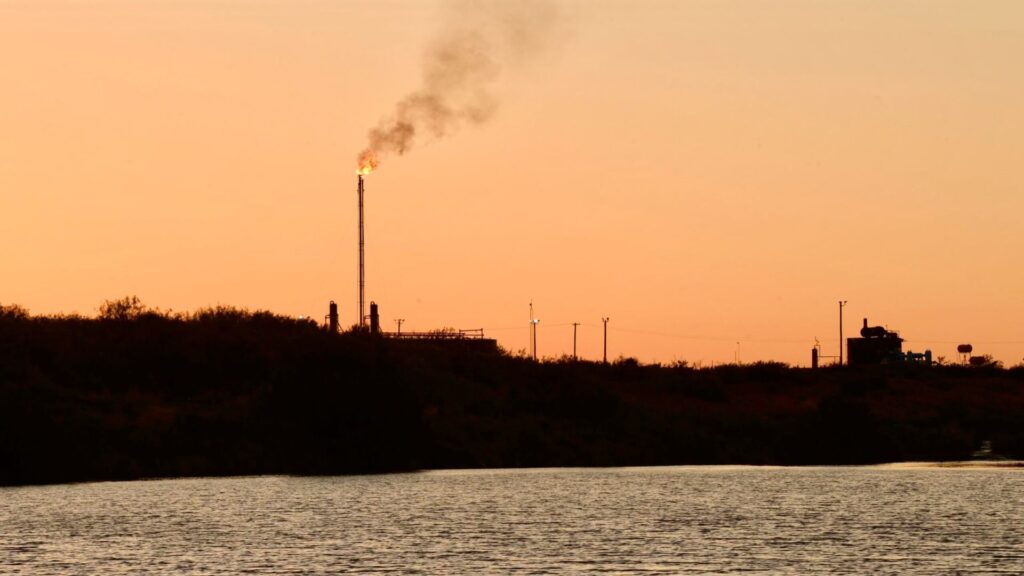
The flaring wellsite, operated by Novo Oil & Gas Northern Delaware, sits smack on the western bank of the Pecos River. As Reid spoke on a placid May afternoon, the flare stack lit up, sounding like a blowtorch and excreting a floppy orange flame and black smoke. Reid wondered aloud, “I thought the state was going to restrict [companies] on how much they could flare.”
A west wind blows the flame and smoke away from his farm and over a torpid slough in the river. There are 64 new or active wells and another 19 oil facilities — tank batteries, flare stacks, pipelines — within a mile of Reid’s hay barn.
Methane is the main component of the natural gas that is burned in flares and it is 80 times more potent than carbon dioxide as a greenhouse gas that warms the climate. Flaring burns off most — but not all — of the methane, producing tons of climate-warming CO2 and a bevy of toxic emissions, including the black soot coming from the flare next to Reid’s farm.
In 2022 New Mexico did, indeed, enact rules to restrict nearly all flaring at oil and gas operations. Even so, oil and gas producers filed more than 36,000 flaring reports with the state in 2025 and almost 24,000 times as of September 2026. Novo Oil & Gas has filed 209 flaring reports for the flare stack next to Reid’s farm since it came online in January 2023.
Novo Oil & Gas did not answer emailed questions about its flaring.
That wellsite is not on his land, but Reid said that he has had wells on his property in the past and had good relationships with the companies. The long-term worry is water.
“Water is a problem. But with the last few years, we’ve been exceptionally well,” he said. “We’ve had enough water to irrigate several times during the year.”
Furthermore, “You can go to the river right now and see that there is a constant flow now going to Texas, which was part of the agreement,” he said.
That’s the 2003 Pecos Settlement Agreement, the answer to a 1974 lawsuit where Texas successfully sued New Mexico, claiming that the latter wasn’t passing along enough of the river’s water under the 1948 Pecos River Compact. The New Mexico portion of the Pecos starts in the high mountains outside Santa Fe and ends at the Texas border. The agreement ensures that New Mexico meets its downstream water obligations to Texas.
Each year, a federally appointed water master decides how much water Texas should receive based on inflows throughout the basin. And while Reid says he has done well this year, for the past seven years New Mexico missed those obligations to Texas by a total 65,200 acre-feet. (By comparison, New Mexico’s biggest city, Albuquerque, uses about 40,000 acre-feet a year.) It is the longest stretch of annual shortfalls since accounting began in 1987.
Last year saw the worst snowpack in recent history in the river’s headwaters. The winter before wasn’t much better. The two winters are part of a decades-long drought exacerbated by climate change that has stressed water planning across the Southwest.
So far, New Mexico has banked enough Pecos water via oversupplies in previous years that it has not been a problem. Yet. When it eventually falls short, the state has purchased water rights from the Carlsbad Irrigation District — which includes Reid’s farms — allowing New Mexico to dump irrigation water into the Pecos. The state also has access to two deep water wells farther north. In 2010, 2013, 2014 and 2015 the state added irrigation water to the Pecos to avoid approaching a cumulative shortfall. Essentially, the state puts farm water into the Pecos to make up for climate-change-induced shortfalls.
Standing next to his alfalfa fields, Reid said, “I’m very proud that the Pecos Valley has been managed to where we’ve got. Not plenty of water, but we’ve had an ample supply to have some good years in producing alfalfa and other crops … and we’re able to maintain our agreement with Texas.”
Even so, “Evidence suggests that available water supplies in New Mexico will decline by 25%-30% in the next 50 years, and this includes the Pecos River,” said Hannah Riseley-White, director of the New Mexico Interstate Stream Commission. “Combine this with a hotter and drier overall climate requiring more frequent irrigation and the demand is very likely to exceed the available supply.”
Reid highlights another issue. “There’s a tremendous amount of irrigation water that could be used for irrigation that’s being used to drill [oil and gas] wells, and then that water is taken back out and disposed [of].” State rules say that no matter the original source, any water that comes out of an oil well can only be used in the oilfields. Cleaning it and using it elsewhere is so far not allowed. The whole situation clearly annoys Reid.
“There are farmers and ranchers who are making more money from selling their groundwater than they make from farming or ranching,” said Haley Jones, an organizer with Citizens Caring for the Future. She lives and works in Carlsbad, the biggest New Mexico town in the Permian Basin. “Sometimes they have kids who don’t want to go into farming or ranching. It’s not an easy life to have.”
Her grassroots group works to protect air, water and community health in the face of the ongoing oil and gas boom in the Permian Basin.
Jones said that some portion of the water used for livestock or crops will eventually make its way back into the ground and recharge the aquifer. But if it goes to the oilfield, “It’s assumed that it’s not going to get back into the aquifer.” It is another way that New Mexico loses some of its water.
The water in Reid’s house is a different problem.
“We can’t drink it anymore,” he said. “You can’t even use it to bathe with because it’s got a high salt content.”
He thinks the contamination comes from oilfield wastewater being injected near his water utility’s domestic wells. “But we don’t have the money to hire a hydrologist to do the scientific work to say, ‘That oil well or that gas well affected our drinking water,’” he said. “We tried to discourage ’em to drill in the proximity of our drinking water and they ignored our concern.”
He said something similar happened to a different domestic water well in the 1970s. “As soon as they started hauling in disposal water, the quality of our drinking water went down. So we moved the water rights to another well farther away. And lo and behold, the same thing happened there: An oil company came in and drilled about 600 feet from it, and there went our water quality in the other well,” he said.
Even so, Reid remains a friend of the oil and gas industry that surrounds him. “Keep on drilling,” he said, repeating a quote he read in a farming magazine. He continued, “It’s a good thing to have to help pay the bills with.”
New Mexico is searching for fixes to the oilfield wastewater problem. Gov. Michelle Lujan Grisham has proposed treating that waste and using it for everything from clean energy production to farm irrigation.
Reid is skeptical. “I don’t think that it can ever be cleared up enough to use it for farm use,” he said. “It was a good idea, but as of the present time, I don’t think we’ve got anything to really celebrate about it.”
State environmental groups feel the same way and want to keep wastewater use restricted to the oilfield. But an industry alliance claims it can be a partial fix for looming shortfalls. The Water, Access, Treatment and Reuse Alliance has a petition before the state Water Quality Control Commission for the third time in as many years to change state rules restricting treated wastewater’s uses. The commission denied the first petition and dropped the second when news reports revealed that Lujan Grisham had possibly meddled in its deliberative process. The current attempt awaits its first hearing.
In early May, the city of Carlsbad turned off the Pecos River. Sort of.
Unlike its headwaters, the river through Carlsbad is fully under human control. The stretch forms a long, skinny lake that can be stopped at the Avalon Reservoir three miles north of town. It can be diverted around town through a flume as well. Occasionally, it is temporarily turned off, dropping the water level so the city can remove trash and allow people to work on their boat docks.
“The river is pretty shallow generally,” Jones said. She has lived in Carlsbad most of her life. The reservoir and the stretch through town — which has parks and public beaches — are the only spots around that are deep enough for small boats to regularly navigate. Even so, Jones said that for Carlsbad’s annual Christmas on the Pecos boat rides — on a stretch known as Lake Carlsbad — the safety spiel notes the life jackets but also says that if you fall out of the boat, “just try standing up. You can probably touch bottom.”
Jones reiterated the arguments made by other environmental groups: The oilfield wastewater treatments are new, and industry isn’t required to disclose all of the chemicals used in drilling wells, making it even more difficult to be sure treated water is “clean.”
Plus, the risks of contaminated water are very real. “That water is used to irrigate food crops and to water livestock. There’s no keeping it out of the food chain,” Jones said. “We swim, boat and fish in the Pecos in town.
“There’s not a way to keep that water from entering humans.”
She said, “I’m not claiming that everyone down here is opposed to it [but] I have yet to speak with a single person down here who is in favor of that or who thinks it’s a good idea.”
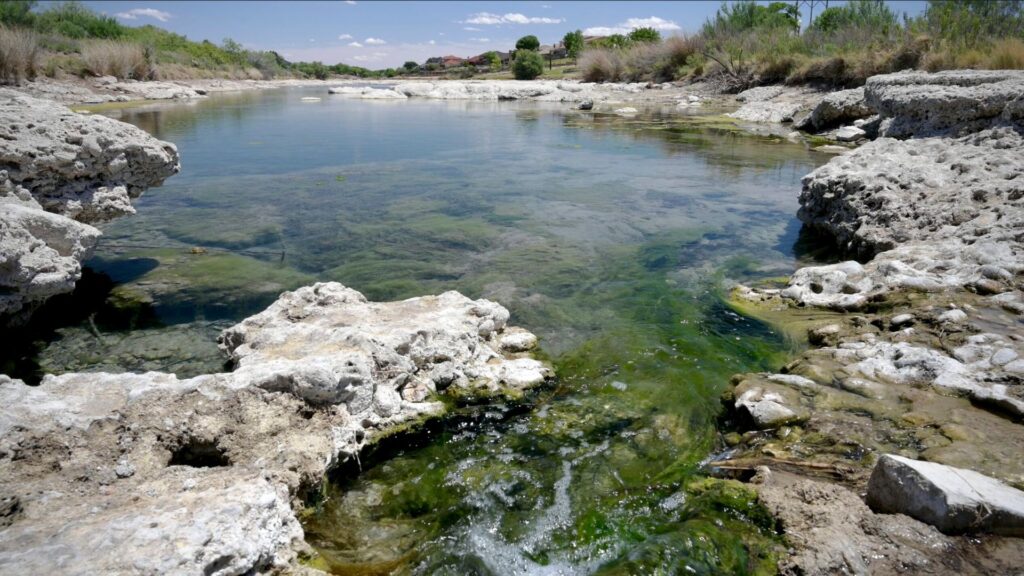
Meanwhile, as Jones talked, on the north side of Carlsbad a stream of water bubbled up from the dry Pecos riverbed. It had run three miles beneath the Avalon Dam and under the dry riverbed before bubbling up and swirling between rocks and grasses, keeping the river wet, if not exactly riverlike, through town.
Despite all of the human impediments arrayed against it, the Pecos still flows.
This story was originally published at Capital and Main, a NMPBS partner. Copyright 2026 Capital & Main.