

Hydroponic greenhouses on the Navajo Nation are growing food with a fraction of the water usually needed
by Bella Davis, New Mexico In Depth
This story was originally published at New Mexico In Depth, a NMPBS partner.
New Mexico In Depth is a participant in the Indigenous Climate Solutions Cohort, part of the Indigenous Journalists Association and Solutions Journalism Network’s Climate Beacon Newsroom Initiative.
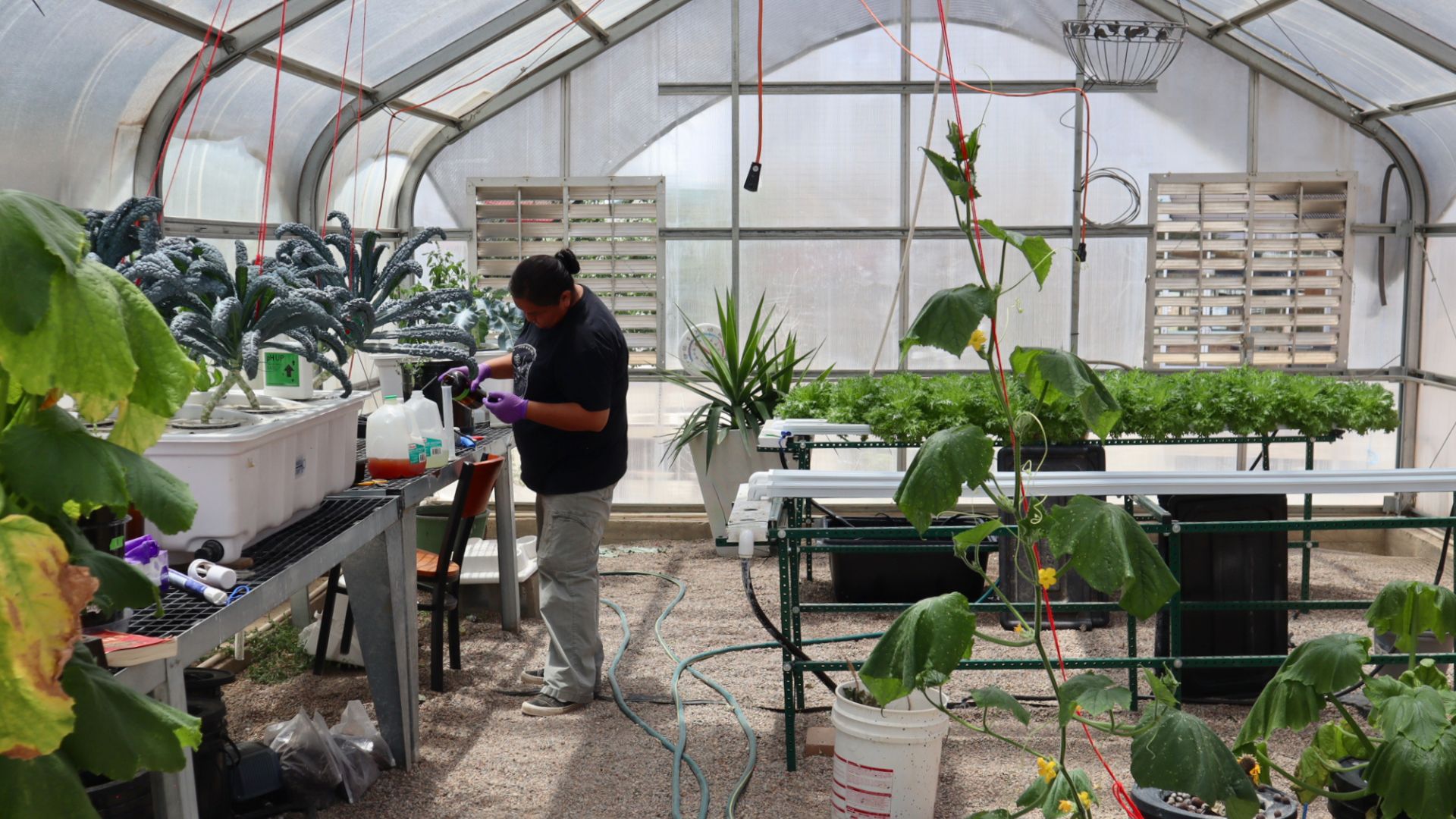
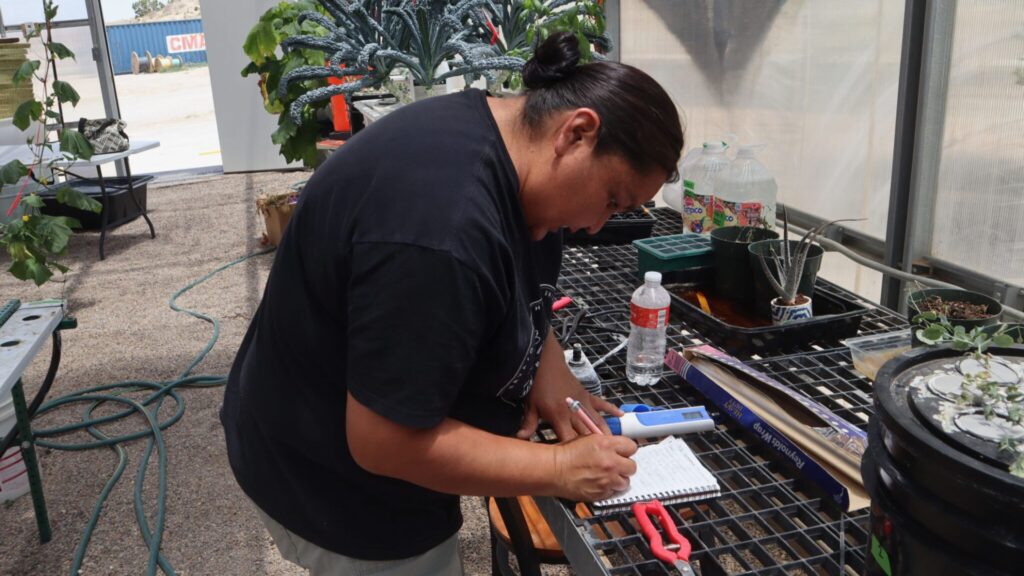
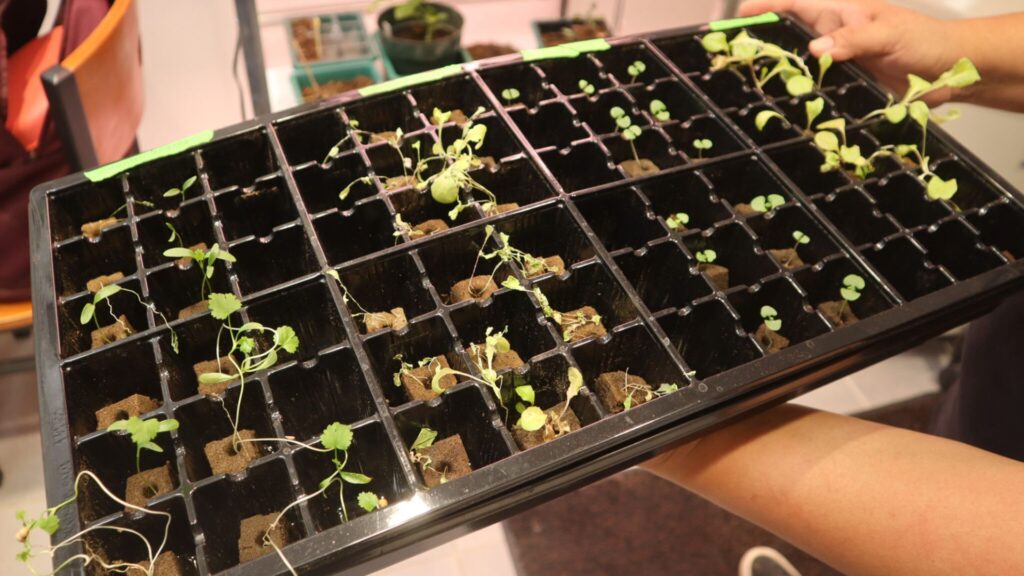
In the humid heat of the Crownpoint greenhouse, Latasha Chiquito made her rounds for the day, measuring the water conditions in each of the tanks and logging her findings in a notebook before making adjustments. Later, with her 18-year-old daughter tagging along, she made the short trip across the Navajo Technical University campus to the biology lab to check on the broccoli and swiss chard seedlings.
It’s been a little over a year since Chiquito (Diné) happened to see a flyer for the university’s hydroponics program, funded by a $650,000 grant from the U.S. Department of Agriculture.
She found out there’s a second greenhouse about 30 minutes away in Mariano Lake, where she was born and raised.
Soon after getting involved with the program, she changed her major from nursing to biology. She’s now a paid intern who manages both greenhouses.
Part of her job is helping organize events where the food is distributed for free to students, staff, and tribal citizens who live in the area.
“People are coming back, like, ‘I love your lettuce. When are you going to have some?’ That makes me feel good,” Chiquito said. “I do feel a sense of accomplishment.”
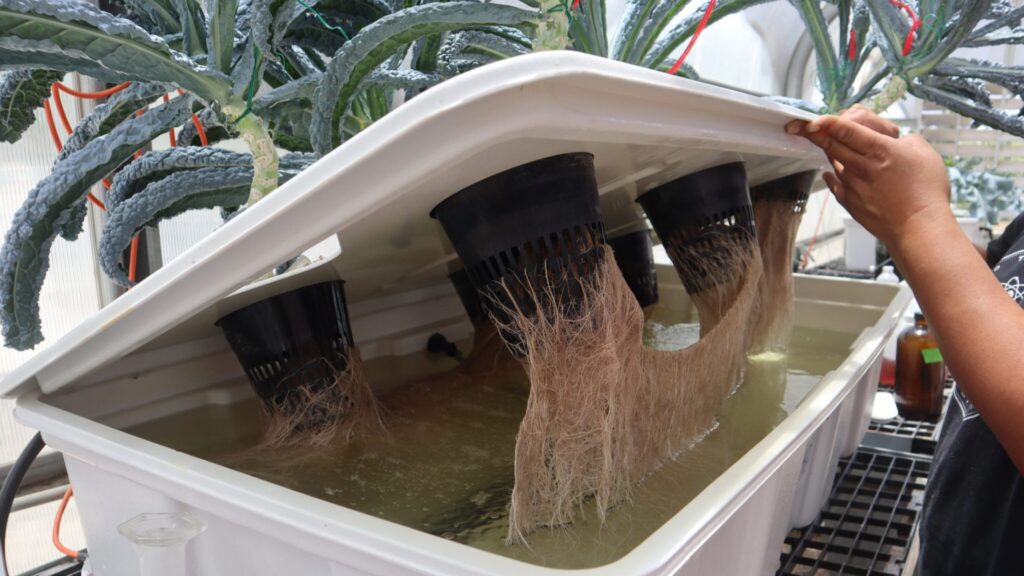
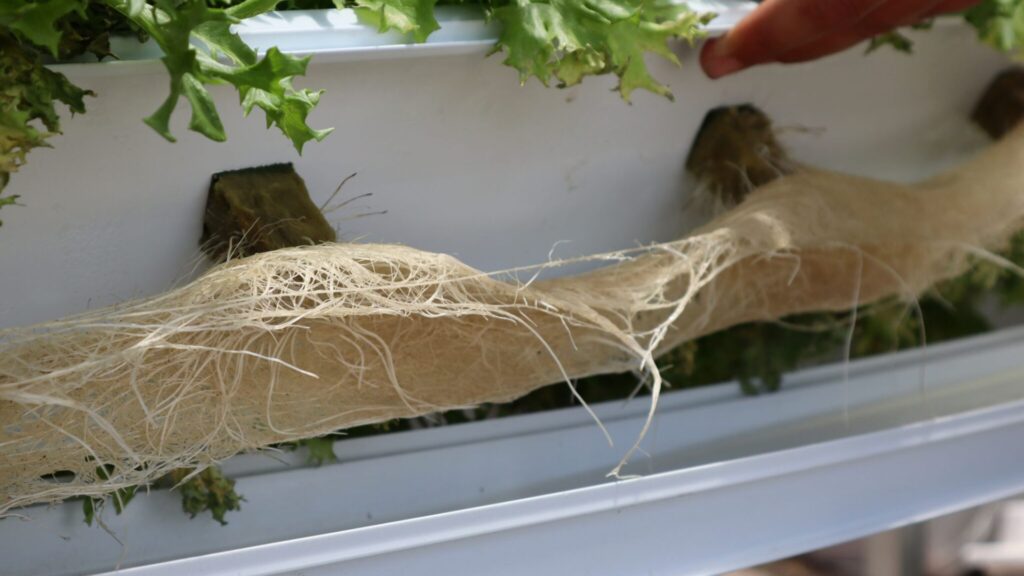
Unlike traditional farming, hydroponic systems don’t use soil, and they require much less water — important features in a region that’s facing heavy metals contamination and severe drought conditions.
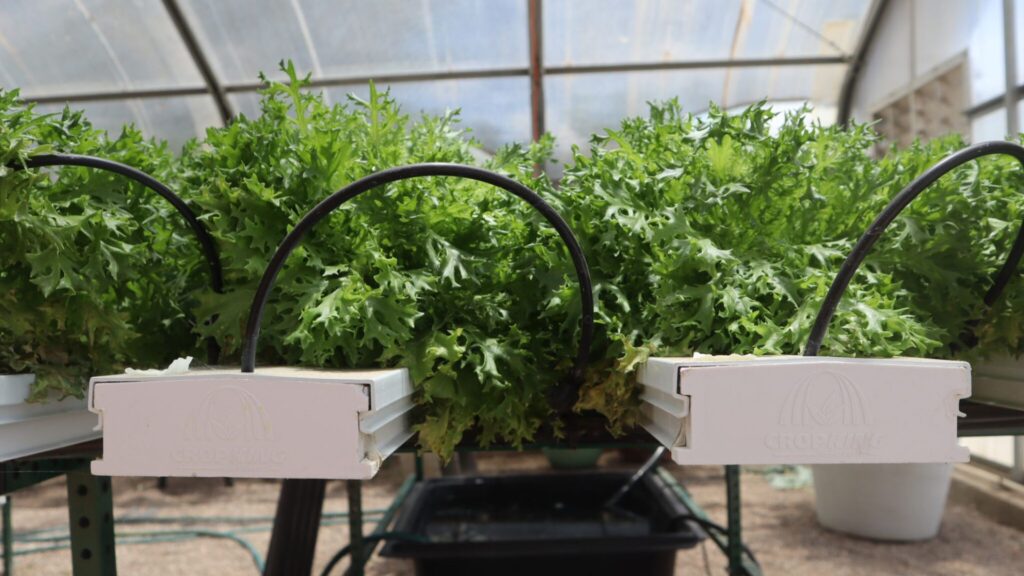
Plants grow instead in a water-based nutrient solution. In some systems, the roots are fully submerged in an aerated tank, while in others, a recycled stream of water flows over the roots in shallow channels. The university greenhouse has a few different systems.
Compared to soil farming, hydroponic production of lettuce in southern Arizona used between 10 to 15 times less water, according to a 2015 peer-reviewed study published in the International Journal of Environmental Research and Public Health.
The program is also meant to help address food insecurity — when households can’t get enough food because of a lack of money or other resources like transportation. In McKinley County, which includes Crownpoint and Mariano Lake, nearly a quarter of the population — 22.9% — struggled with food insecurity in 2023 compared to 16.6% for New Mexico overall and 14.3% nationwide, according to a Feeding America study.
Projects at the university start with questions from students, said Irene Ane Anyangwe, a professor with a doctorate in microbiology who’s also the principal investigator for the grant.
This project was no different. Her students analyzed soil in the area several years ago and found high levels of heavy metals, stemming partly from abandoned uranium mines that are spread across the Navajo Nation. From there, they wanted to know: How can food be grown safely and sustainably in their communities?
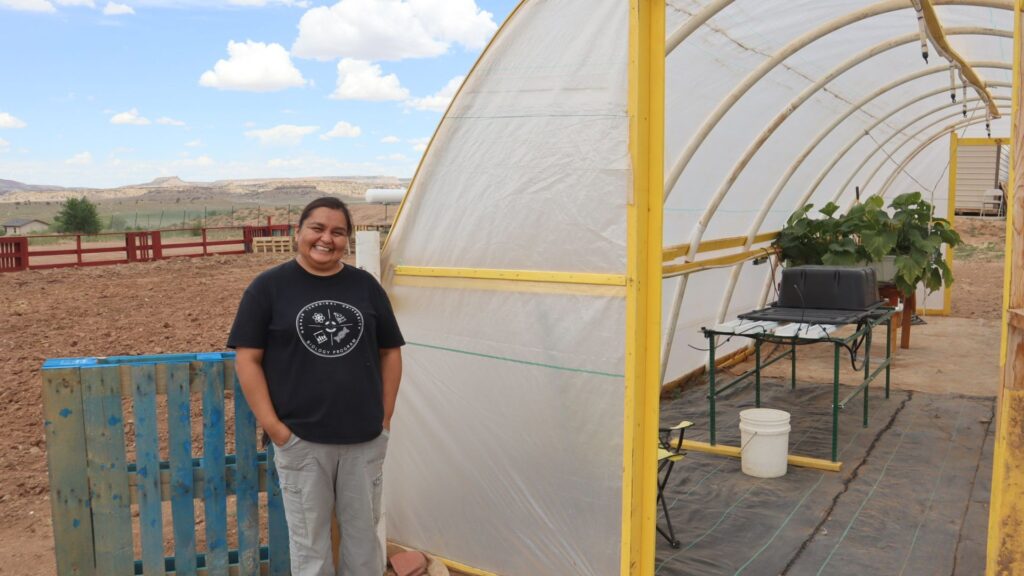
While hydroponic systems need less water than soil farming, there’s a tradeoff: They typically use more electricity — to power lighting, climate control, and water pumps. That also introduces the risk of power outages taking out crops.
A storm earlier this summer caused an outage at the Mariano Lake greenhouse, and the lettuce wilted in less than a day.
“I was so devastated,” Chiquito said. “But we started the water, and I was telling my daughter, ‘Let’s just fill it up, see what happens.’ The next day, we came back and it was fluffy.”
That experience prompted Chiquito and Anyangwe to talk about exploring solar energy.
They both have other hopes for the program’s future, too.
Last month, Anyangwe spoke to state lawmakers on the Science, Technology and Telecommunications Committee about the program’s progress.
“Some farmers within the community are getting to know about this, and they want to reach out to us to see how we can help,” Anyangwe said. “We are not at that point yet because we still have to perfect our system. We are still training our students and still learning from their mistakes.”
High start-up costs would also be a challenge in setting up more greenhouses, she said.
But hydroponics can be affordable, according to Breanna Lameman (Diné), a PhD student at the University of Arizona researching food sovereignty and environmental justice, who grew up farming with her family in Shiprock. After discovering hydroponics while working on her master’s degree in public health at the university, she started a program doing demonstrations for interested communities on how to set up small-scale systems at home.
One of the cheapest methods, Lameman said, is growing food in mason jars, which doesn’t require a pump.
“I buy my own supplies and kind of just build it myself,” she said. “I think figuring out how to be cost efficient in that way is great, but it also takes a lot of research. How can I buy this cheaper? Where can I buy it? And even buying these supplies, you do have to go to border towns, or the nearest city.”
Anyangwe wants to apply for another phase of the USDA grant and collaborate with other tribal colleges and universities, she told lawmakers during last month’s committee hearing.
“There is a huge opportunity for us to work on expanding what you’re doing here across the state, but particularly to this region of our state,” said Rep. Tara Lujan, D-Santa Fe.
Chiquito, meanwhile, is interested in growing new kinds of crops. To that end, she’s invited Diné elders from Mariano Lake to tour the greenhouse there.
“I just wanted to give them a little insight of how we’re growing the vegetables,” she said. “Some of the vegetables that I want to grow are sacred, like our Navajo squash and our corn, so I kind of want to get their approval. … The main thing that we might kind of have a struggle with is the elders believe that we should grow with Mother Earth. I’m kind of like, hey, this is our other sacred element, it’s water. We can do this too.”
From Lameman’s perspective, too, hydroponic farming can be compatible with traditional Diné beliefs.
“Hydroponics is just an alternative tool, and it doesn’t replace anything. It doesn’t replace our relationship to the land. It’s just how we’re adapting to this environment, which is caused by colonization, which is caused by these greedy corporations,” Lameman said, referring in part to climate change.
This story was originally published at New Mexico In Depth, a NMPBS partner.